
Dry Needling in Melaka
Thin filament needles inserted into muscle trigger points for immediate release.
That stubborn knot in your shoulder that no amount of massage can release. The tight band in your calf that cramps every time you run.
Some trigger points are too deep for hands to reach - dry needling goes straight to the source.
What it is
Dry needling is the insertion of sterile single-use filament needles (0.25mm, roughly one-third the diameter of an injection needle) through the skin directly into a myofascial trigger point or dysfunctional muscle. 'Dry' means no substance is injected - only the needle.
In Malaysia, dry needling is within the scope of physiotherapy practice for MAHPC-registered physios who have completed accredited post-graduate needling courses. It is not the same as medical acupuncture or traditional Chinese acupuncture.
Mechanism
The needle elicits a local twitch response (an involuntary brief muscle contraction) in the taut band. This is associated with: (1) a drop in endogenous acidic metabolites that sensitise pain receptors, (2) normalisation of the motor endplate dysfunction underlying the trigger point, (3) segmental pain modulation at the spinal cord level, and (4) a mild inflammatory response that promotes local blood flow and tissue remodelling.
What it helps
Strongest evidence for chronic neck pain with upper-trapezius and levator-scapulae trigger points, cervicogenic headache, lateral epicondylalgia (tennis elbow) with extensor-carpi-radialis-brevis involvement, shoulder impingement with infraspinatus trigger points, gluteal trigger points driving chronic low back or buttock pain, and calf trigger points in runners. Moderate evidence for plantar fasciitis, patellofemoral pain, and TMJ dysfunction.
Comparison vs alternatives
Against massage: dry needling reaches trigger points in deep muscles (piriformis, infraspinatus, sub-occipitals) that thumbs cannot sustain pressure on. Against cortisone injection: dry needling has no steroid side effects and can be repeated safely.
Against acupuncture: dry needling targets specific Western-medicine trigger points rather than meridian points and is chosen after a musculoskeletal physio assessment.
Who it is NOT for
Absolute: needle phobia severe enough to cause vasovagal collapse, active local infection or cellulitis, lymphoedema in the treatment limb. Relative: anticoagulant therapy (warfarin, apixaban - bruising risk), bleeding disorders (haemophilia), immunosuppression, first-trimester pregnancy, metal allergy.
Over the chest wall in slim patients, extreme care is needed to avoid pneumothorax - only physios trained specifically in thoracic needling should treat this region.
Preparation
Eat something 1-2 hours before - empty-stomach needling increases vasovagal (faint) risk. Hydrate well.
Avoid alcohol for 12 hours before and 24 hours after. Wear clothing that gives access to the target area.
The session
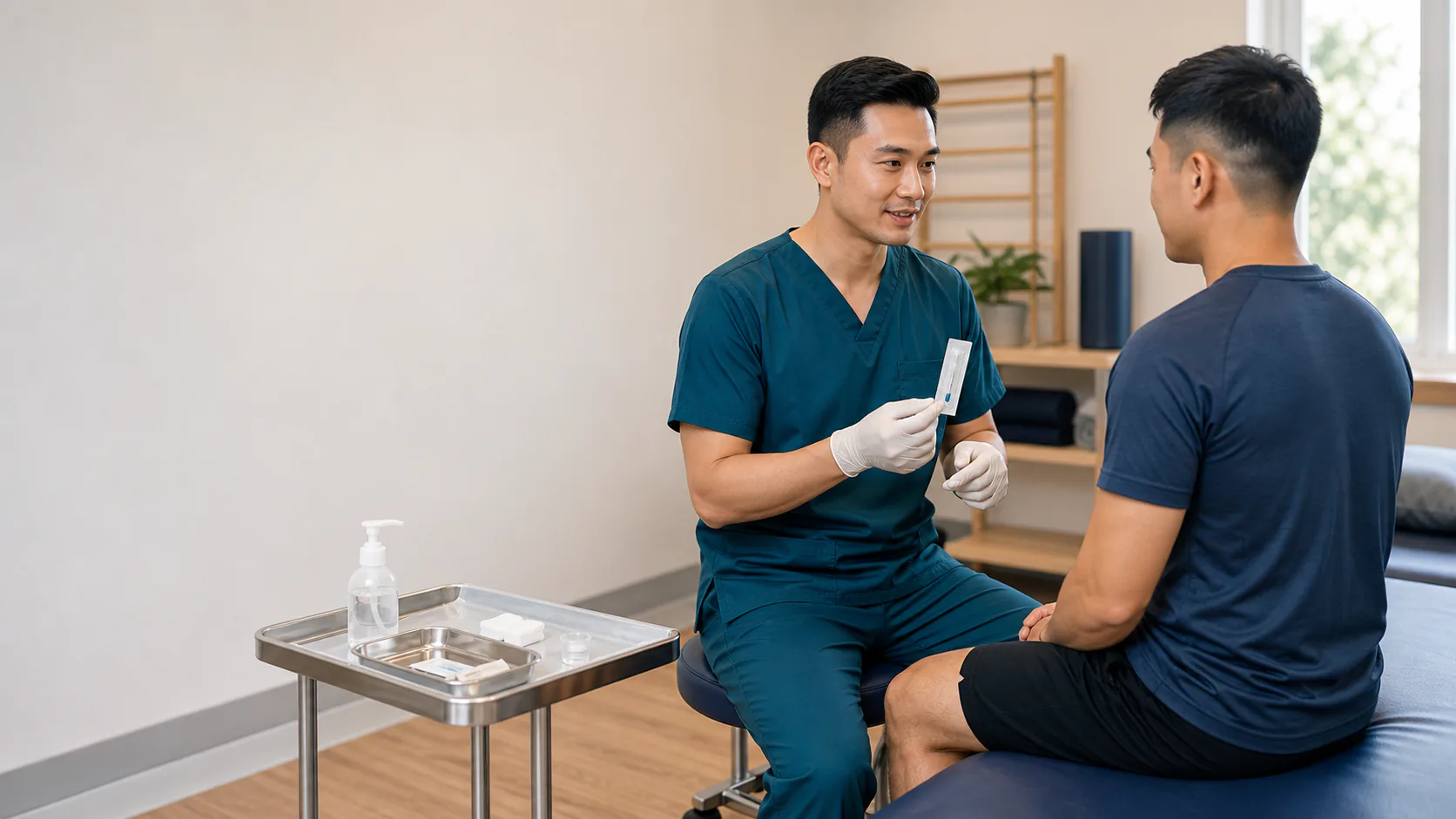
Your Melaka physio uses gloved hands to palpate the trigger point, swabs the skin with alcohol, and inserts the needle through a guide tube. You feel a small pinch on skin entry and a brief deep ache or cramp when the needle meets the taut band - this is the local twitch response and is the therapeutic goal.
Needles stay in 10-30 seconds for 'in-and-out' technique, or up to 10-15 minutes for longer retention. 3-6 trigger points are typically treated per session.
Typical course
4-6 sessions at weekly intervals for chronic trigger-point syndromes. Acute muscle guarding often responds in 2-3 sessions.
Re-assessment at session 3 determines whether to continue.
Side effects
Common: bruising, localised soreness for 24-48 hours ('post-needle soreness'), and transient drowsiness after large-volume sessions. Uncommon: brief vasovagal faint.
Rare but serious: pneumothorax (only with thoracic needling - strict training required), infection (extremely rare with single-use sterile needles).
Cost in Melaka
Dry needling is usually an add-on to the standard physio session: RM30-70 extra depending on the number of sites needled. Full session with dry needling: RM100-180 at private clinics.
Availability
Only a subset of physio clinics in Melaka offer dry needling - it requires specific post-graduate certification. Availability is better in Melaka Tengah and Ayer Keroh; limited at home-visit and some smaller neighbourhood clinics.
Hospital Melaka physiotherapy department does not routinely offer dry needling - private only. WhatsApp us if you want to be matched to a dry-needling-certified physio.
How It Works
The science
Dry needling uses a thin, solid filament needle (the same kind used in acupuncture, but different philosophy and targeting) to penetrate a myofascial trigger point - a taut, irritable nodule in a muscle. The mechanical insertion triggers a local twitch response, disrupts the dysfunctional motor endplate, and produces a neurophysiological cascade: reduced peripheral nociception, altered descending pain modulation, and temporary inhibition of overactive muscle.
What you feel
Surprise at how thin the needle is - most patients do not feel insertion. When the physiotherapist reaches the trigger point, you will feel a brief, deep twitch or cramp that releases within a second.
Some patients describe mild soreness the next day, similar to after a good gym session. Numbness, tingling, or sharp lasting pain is not normal and the technique is adjusted immediately.
Session protocol
Skin is alcohol-swabbed, the physiotherapist palpates to the trigger point, inserts a needle (typically 30–50mm depending on muscle depth), and applies piston-like movement until twitch responses stop or fade. A session uses 3–8 needles across relevant muscles, and typically takes 10–20 minutes of actual needling within a 30–45 minute appointment.
Evidence base
Strong evidence for short-term pain reduction in myofascial pain syndrome, cervicogenic headache, plantar heel pain, and chronic low back pain. Moderate evidence for shoulder impingement, lateral epicondylitis, and knee osteoarthritis.
Effect is comparable to or slightly better than trigger-point manual release, with the advantage of reaching deeper muscles hands cannot access.
Who benefits most
Patients with clearly palpable, reproducible trigger points that reproduce familiar pain on compression. Common presentations: tension headache from upper trapezius and suboccipital triggers, lateral hip pain from gluteus medius triggers, "sciatica-feeling" pain from piriformis or deep gluteal triggers, and calf cramps from soleus triggers.
When it's not the right pick
Dry needling is avoided in patients with needle phobia, local infection, severe bleeding disorders, high-dose anticoagulation (case-by-case), and pregnant patients in the first trimester or over the abdomen and sacrum. It is not used as a replacement for imaging in red-flag presentations, and pain that is clearly radicular (nerve root) responds better to movement-based approaches.
Realistic timeframe
Immediate relief within the session is common but often partial. Cumulative benefit builds over 3–6 sessions when combined with corrective exercise.
If a trigger point keeps reloading week after week, the clinician should be hunting the driver - posture, movement fault, workload - not needling the same spot forever.
How it fits into the bigger plan
Dry needling is a precision reset. It is most powerful when used to release the one or two muscles that have been blocking progress in rehab, so exercise can do its job.
At PhysioMelaka it is always paired with motor re-education: needle the overactive muscle, then activate the underactive one. Needling without the re-education is a short-term fix on a loop.
Conditions Treated
Conditions commonly treated with dry needling in Melaka.
Back Pain
Back pain from disc, joint, or muscle issues. Physio finds the real cause and fixes it instead of masking it with painkillers.
Learn More →Neck Pain
Neck pain from desk work, poor sleep posture, or whiplash. Targeted physio releases tight muscles and restores mobility.
Learn More →Shoulder Pain
Shoulder pain from rotator cuff issues, impingement, or frozen shoulder. Physio restores full overhead reach.
Learn More →Tennis Elbow
Lateral epicondylitis from overuse. Physio treats the tendon with eccentric loading - no injection or surgery needed.
Learn More →Related Services
Physiotherapy services that use dry needling.
Related Treatments
TENS Electrical Stimulation
Electrical nerve stimulation that blocks pain signals to the brain. Drug-free relief for chronic pain.
Learn More →Shockwave Therapy
High-energy acoustic waves that restart healing in chronic tendon injuries.
Learn More →Cupping Therapy
Suction cups that release deep muscle tension and improve blood flow. Used alongside physio exercise.
Learn More →Massage Therapy
Clinical massage techniques that release specific muscle trigger points and adhesions.
Learn More →From Our Blog
Articles covering dry needling and related topics.
What Is Physiotherapy? A Complete Guide for Melaka Residents
Everything you need to know about physiotherapy - what it treats, how it works, and where to find it in Melaka.
Read article → conditionsKnee Pain: Why It Happens and How Physiotherapy Fixes It
From runner's knee to osteoarthritis - understand your knee pain and learn how physiotherapy can help you move pain-free again.
Read article → sportsFutsal Injuries in Melaka: Prevention, Treatment, and Return to Play
Futsal is Melaka's most popular sport - and the top cause of sports injuries. Here's how to prevent, treat, and recover from common futsal injuries.
Read article →Frequently Asked Questions
No. Acupuncture follows traditional Chinese medicine meridian points. Dry needling targets specific muscle trigger points identified through Western medical assessment.
The needles are similar but the reasoning, targets, and treatment goals are different.
The needle insertion feels like a small pinch. When the needle hits a trigger point, you feel a brief muscle twitch - it is uncomfortable for 1-2 seconds but signals that the treatment is working.
Afterward, the area may feel bruised for 24-48 hours. Most patients say the brief discomfort is worth the lasting relief.
Most trigger points respond within 2-4 sessions. Chronic, long-standing trigger points may need 5-6 sessions.
Your physio reassesses after each session. Dry needling is always combined with exercise and stretching to prevent the trigger points from returning.
Yes. Every reputable physio clinic in Melaka uses sterile, single-use, disposable filament needles supplied in sealed packaging - the same standard as hospital needles.
Needles are opened in front of you, used once, and immediately disposed of in a medical sharps container. Your physio uses gloves and cleans your skin with alcohol before insertion.
Infection rates are vanishingly rare - far lower than 1 in 10,000.
Yes in most cases, but be aware that some patients feel unusually tired, sleepy, or lightly lightheaded for 1-2 hours after an intensive session - a normal post-needling parasympathetic response. If it is your first-ever session, consider having someone drive you or arrange Grab for the return trip.
Drink water, eat a small snack, and sit for 10 minutes before leaving. Avoid heavy exercise, sauna, and alcohol for 24 hours after.
Interested in Dry Needling?
No referral needed. WhatsApp us and we'll connect you with the right physiotherapist in Melaka.
WhatsApp Us Now