
Exercise Prescription in Melaka
Specific exercises prescribed for your condition, progression, and goals. The foundation of every physio programme.
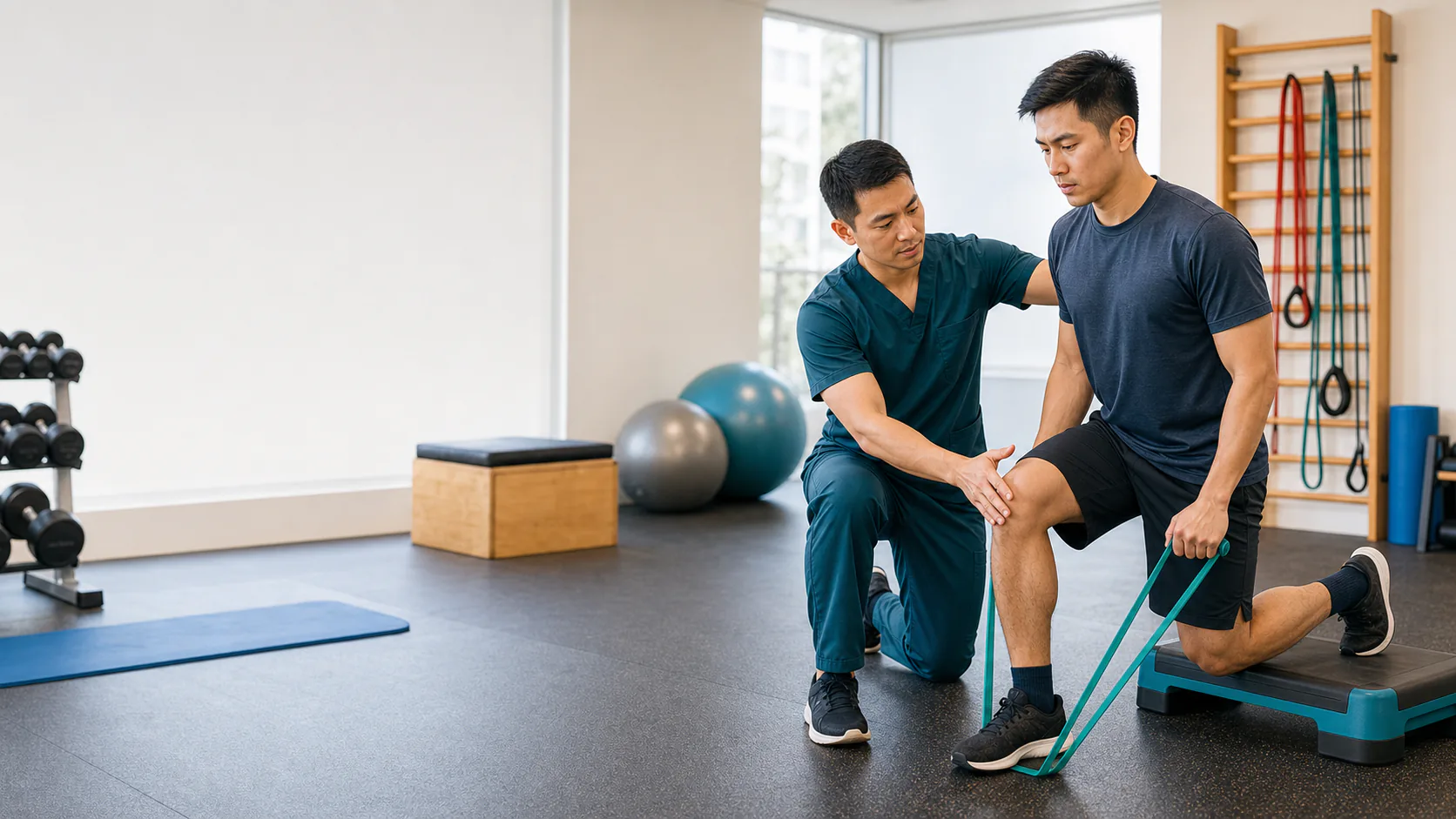
Your doctor said "do some exercises." You Googled stretches and tried a few random YouTube routines. But nothing changed - or worse, the pain got worse.
That is because general exercise is not the same as prescribed exercise. The wrong exercise at the wrong time can set your recovery back.
What it is
Exercise prescription is the process of selecting specific exercises - with defined dose (reps × sets), load, tempo, frequency, and progression criteria - to address the measurable impairments identified in your physio assessment. It is the single most evidence-backed intervention in musculoskeletal physiotherapy.
Mechanism
Exercise works through multiple mechanisms: progressive overload drives tissue adaptation (tendon stiffness, muscle cross-sectional area, bone density); motor control training re-wires faulty movement patterns into efficient ones; cardiovascular work improves tissue delivery of oxygen and nutrients; and the analgesic response to exercise reduces pain sensitivity globally within 30 minutes of a session.
What it helps
Virtually every musculoskeletal condition - chronic low back pain, knee osteoarthritis, rotator-cuff tendinopathy, non-specific neck pain, ACL rehab, hip replacement recovery, ankle sprain recovery. Also central for neurological rehab (stroke, Parkinson's), cardiorespiratory conditioning, and geriatric fall prevention.
The specific exercise differs - the principle is the same.
Comparison vs alternatives
For chronic low back pain, knee osteoarthritis, and rotator-cuff tendinopathy, exercise therapy has stronger evidence than passive modalities (ultrasound, TENS, massage alone). For knee OA, exercise has similar pain-relief to NSAIDs with far better long-term outcomes and no gastric or kidney risk.
For chronic tendinopathy, exercise with progressive loading outperforms both injection and surgery at 1 year.
Who it is NOT for
Exercise is rarely contraindicated entirely, but specific exercises are avoided when the underlying tissue cannot tolerate load: acute fractures until union, unstable cardiac conditions, severe uncontrolled hypertension, recent surgery within the surgeon's early-protection phase, red-flag symptoms (cauda equina, saddle anaesthesia, suspected serious pathology). Even then, most patients can do something - a trained physio finds the safe dose.
Preparation
Wear comfortable workout clothing to your session. Arrive slightly hydrated.
Tell your physio about any cardiac, respiratory, or diabetic conditions so they can modify intensity. Avoid a heavy meal in the hour before.
The session
Your Melaka physio demonstrates each exercise with clear positioning and cueing, watches you perform 2-3 reps to check form, and corrects compensations. You get a take-home sheet with videos or QR-code links.
A typical initial programme has 3-5 exercises totalling 15-20 minutes.
Typical course
Home exercises are done 5-6 days per week. Review with physio at 1-2 week intervals to progress load, change exercises, or add complexity.
Most patients feel meaningful change at 4-6 weeks, measurable strength/range change at 8-12 weeks. Tendinopathy and post-surgical cases may run 3-6 months.
Side effects
Mild muscle soreness (DOMS) 24-48 hours after new or heavier exercises is normal. Sharp pain, joint swelling lasting 24+ hours, or pain worse the next morning than last night = back off and tell your physio.
Cost in Melaka
Exercise prescription is included in every physio session (government RM5 with referral, private RM70-120). Some clinics also run small-group supervised exercise classes ('rehab gym') at RM25-40 per session.
A yoga mat and a RM30-50 resistance-band set from Decathlon Ayer Keroh covers 95% of home-programme needs.
Availability
Every physio clinic in Melaka prescribes exercise - it is the core of modern practice. Hospital Melaka offers outpatient group rehabilitation for stroke, cardiac, and orthopaedic patients.
MITC-area and Ayer Keroh clinics typically have small gym spaces with Swiss balls, dumbbells, and cable resistance. Home-visit physios bring portable resistance bands.
How It Works
The science
Tissue adapts to the load you put through it - Wolff's law for bone, Davis's law for soft tissue, the principle of specificity for the nervous system. Exercise prescription is the deliberate, dosed exposure of tissue to load so it rebuilds stronger than before.
It is the only physiotherapy tool with conclusive long-term evidence across nearly every musculoskeletal diagnosis.
What a good session looks like
Your physiotherapist watches you move, picks 4–8 exercises that target the exact fault (weak glute, tight hip flexor, poor scapular control), assigns specific sets, reps, and tempo, and progresses them week by week. The plan is boring, repeatable, and quantifiable - "three sets of ten at this weight" - not "do some stretches."
Dosing and progression
Dose is everything. Under-dose and tissue does not adapt; overdose and you flare.
A typical progression: weeks 1–2 isometric or low-load for symptom tolerance, weeks 3–4 moderate-load with full range, weeks 5–8 heavy slow-resistance or plyometric depending on goal. Reassessment every 2–3 weeks decides whether to push or hold.
Evidence base
The strongest in physiotherapy. Exercise therapy beats placebo, sham, and passive modalities for chronic low back pain, neck pain, knee osteoarthritis, rotator cuff tendinopathy, hip osteoarthritis, patellofemoral pain, Achilles tendinopathy, plantar fasciitis, hamstring strain, and fall prevention in the elderly.
It is also non-inferior to surgery for many shoulder and knee conditions.
Who benefits most
Everyone. From a 19-year-old sprinter rehabbing a hamstring, to a 72-year-old post-hip-replacement patient relearning to stand from a chair, to a post-stroke patient rebuilding reach-to-grasp.
The specific exercises change; the principle does not.
When it's not enough on its own
Acute red-flag injuries - suspected fracture, full ligament rupture, cauda equina, suspected cancer - need imaging and medical workup first. Severe flare-ups may need temporary symptom modulation (TENS, taping, manual therapy) before exercise is tolerable.
Exercise solves the long game; it is rarely the first thing done in the first 48 hours of acute injury.
Realistic timeframe
Neural adaptations (feeling stronger, moving more confidently) appear in 2–3 weeks. Muscle hypertrophy takes 4–8 weeks.
Tendon remodelling takes 8–12 weeks. Bone takes months.
If someone promises a magic exercise fix in a week, they are selling you something.
How it fits into the bigger plan
Exercise is the entire plan. Every other modality in physiotherapy - ultrasound, cupping, taping, shockwave, manual therapy - exists to make exercise possible, tolerable, or more effective.
If your physiotherapy plan does not include a progressive exercise component, you are not receiving physiotherapy; you are receiving passive treatment with physiotherapy branding.
Conditions Treated
Conditions commonly treated with exercise prescription in Melaka.
Back Pain
Back pain from disc, joint, or muscle issues. Physio finds the real cause and fixes it instead of masking it with painkillers.
Learn More →Neck Pain
Neck pain from desk work, poor sleep posture, or whiplash. Targeted physio releases tight muscles and restores mobility.
Learn More →Knee Pain
Knee pain from arthritis, sports, or wear-and-tear. Physio strengthens the structures around your knee so the joint stops hurting.
Learn More →Shoulder Pain
Shoulder pain from rotator cuff issues, impingement, or frozen shoulder. Physio restores full overhead reach.
Learn More →Related Services
Physiotherapy services that use exercise prescription.
Sports Physiotherapy
Targeted rehab for sports injuries. From ACL tears to runner's knee - treated by physios who understand sport.
Learn More →Geriatric Physiotherapy
Physiotherapy for seniors to prevent falls, maintain mobility, and keep elderly patients independent at home.
Learn More →Musculoskeletal Physiotherapy
The most common type of physio. Treats muscle, joint, and bone pain from any cause.
Learn More →Related Treatments
Taping & Strapping
Athletic and kinesiology taping that supports injured structures while allowing movement.
Learn More →Heat & Cold Therapy
Strategic use of heat and cold to manage pain and swelling. Heat relaxes tight muscles; cold calms inflammation.
Learn More →Massage Therapy
Clinical massage techniques that release specific muscle trigger points and adhesions.
Learn More →Electrotherapy
Various electrical modalities including interferential therapy, NMES, and EMS. Reduces pain and accelerates tissue healing.
Learn More →From Our Blog
Articles covering exercise prescription and related topics.
What Is Physiotherapy? A Complete Guide for Melaka Residents
Everything you need to know about physiotherapy - what it treats, how it works, and where to find it in Melaka.
Read article → conditionsKnee Pain: Why It Happens and How Physiotherapy Fixes It
From runner's knee to osteoarthritis - understand your knee pain and learn how physiotherapy can help you move pain-free again.
Read article → sportsFutsal Injuries in Melaka: Prevention, Treatment, and Return to Play
Futsal is Melaka's most popular sport - and the top cause of sports injuries. Here's how to prevent, treat, and recover from common futsal injuries.
Read article →Frequently Asked Questions
Most home exercise programmes should be done daily for 15-20 minutes. Consistency beats intensity - doing exercises every day for 15 minutes beats a 1-hour session twice a week.
Your physio adjusts frequency based on your condition.
Mild discomfort during exercise is normal and expected - it means you are working the right muscles. Sharp pain or pain that worsens the next day is a red flag.
Tell your physio if this happens. They will modify the exercise or reduce the intensity.
The goal is "comfortably uncomfortable" - challenging but not painful.
YouTube exercises are generic - they do not account for your specific condition, injury stage, or movement compensations. A physio prescribes exercises based on your assessment findings and progresses them as you improve.
The wrong exercise at the wrong time can worsen your condition or create new problems.
Rarely. 90% of physio home exercises use body weight, a resistance band, or household items (a water bottle as a light weight, a towel for sliding drills).
For knee and hip rehab, a set of resistance bands (RM30-50 at Decathlon Ayer Keroh, Sports Direct MITC, or Shopee) covers most needs. Only sport-return or advanced strength phases typically require proper gym equipment, and your physio will let you know when and where.
Your physio re-measures objective markers every 2-4 weeks - range of motion with a goniometer, strength with a hand-held dynamometer, functional tests like single-leg hop distance, pain scores, and disability questionnaires (ODI for back, KOOS for knee). Numbers on paper beat opinions - you will see your squat depth increase, your Y-balance reach extend, your dynamometer readings climb.
Many Melaka clinics share these metrics with you on WhatsApp after each reassessment.
Interested in Exercise Prescription?
No referral needed. WhatsApp us and we'll connect you with the right physiotherapist in Melaka.
WhatsApp Us Now