
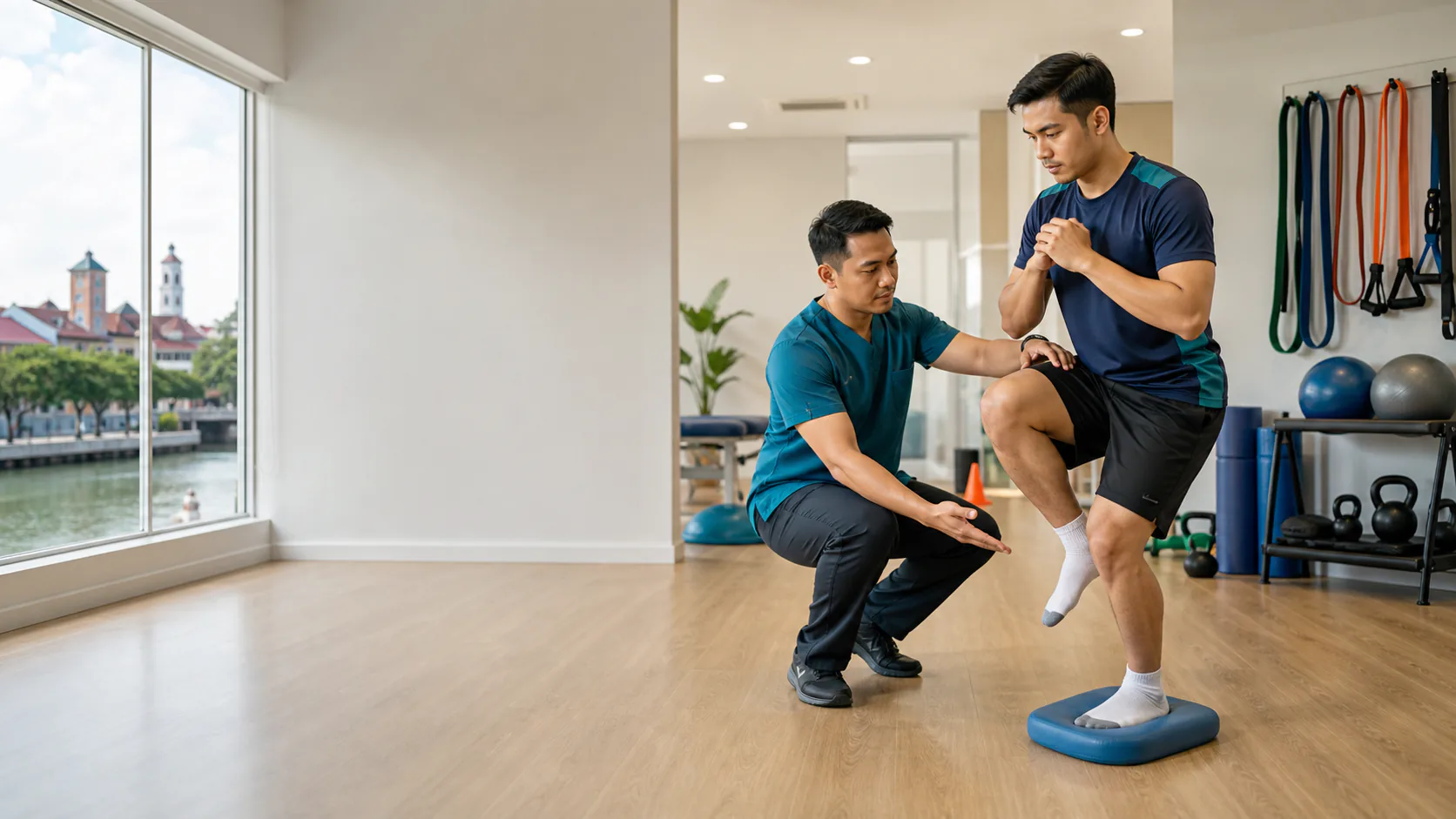
You tore your ACL at futsal last month. Or your shoulder gave out mid-serve.
Now you're stuck on the sideline watching everyone else play - and the longer you wait, the harder the comeback gets.
Definition
Sports physiotherapy is a specialist branch of physiotherapy focused on prevention, assessment, treatment and return-to-sport of injuries in active people. It covers pre-season screening, acute injury management, post-operative rehab (especially ACL, meniscus, rotator cuff), chronic overuse injuries (tendinopathies, stress fractures), and performance optimisation.
Who it's for
Recreational footballers and futsal players at MITC and the Hang Tuah Mall courts, badminton players at Melaka Sports Complex, runners training along the Melaka River and Klebang Beach, cyclists on the Alor Gajah back roads, and weekend athletes who discover their knees have opinions after age 35.
Mechanism - why it works
A sports physio does not just treat the painful part. Assessment screens the whole kinetic chain: ankle mobility, hip strength, trunk control, and sport-specific movement patterns.
Treatment combines manual therapy for restrictions, progressive loading for weak tissue, neuromuscular retraining, and sport-specific drills. Outcome is measured against objective return-to-sport criteria, not pain alone.
Comparison vs general physiotherapy
General physio focuses on pain relief and day-to-day function. Sports physio adds performance metrics - hop tests, single-leg squat depth, sprint speed, jump symmetry - and designs rehab around the demands of your sport.
For ACL reconstruction, a sports-physio-led rehab programme typically halves the re-injury rate compared to generic rehab.
Comparison vs rest-and-hope
Rest without structured loading lets connective tissue heal in a weakened state. That is why many injuries recur within months of returning to sport.
Progressive loading under a sports physio is what makes the repaired tissue withstand sport-specific forces.
Preparation
Wear sports kit you can move in. Bring your regular sport footwear (running shoes, football boots, badminton shoes).
If you were injured, bring any imaging and the medical report. Be specific about your goal: 'run a half-marathon in 12 weeks' is workable; 'get better' is not.
Recovery timelines by injury
Grade 1 ankle sprain: 2–3 weeks. Hamstring strain: 4–6 weeks.
Rotator-cuff tendinopathy: 8–12 weeks. ACL reconstruction: 9–12 months return to sport.
Achilles tendinopathy: 12 weeks eccentric loading programme.
When NOT to go straight to a sports physio
Suspected fracture, dislocation, obvious deformity, or inability to weight-bear on a leg injury - go to Hospital Melaka emergency or Mahkota Medical Centre first. Sports physio can and should follow after imaging clears the structural question.
Melaka options
Sports-focused physiotherapy clinics cluster in Bukit Beruang (near Multimedia University student athletes), Ayer Keroh (near the Melaka Sports Complex and Pantai Hospital), and Melaka Tengah. Return-to-sport testing equipment (force plates, isokinetic dynamometers) is available at the larger private clinics near Mahkota Medical Centre.
Costs
Initial assessment RM80–150. Follow-up RM70–120.
Return-to-sport testing session RM150–300. A typical ACL rehab 9-month package of 30–40 sessions costs RM2,400–4,800, usually spread monthly.
Insurance
Sports injury rehab is covered by most Malaysian medical insurance with a doctor's referral (GP or orthopaedic) and diagnosis letter. Corporate plans often include a per-year physio ceiling (RM1,500–3,000).
Ask your physio for an itemised MAHPC-registered receipt.
相关病症
Knee Pain
Knee pain from arthritis, sports, or wear-and-tear. Physio strengthens the structures around your knee so the joint stops hurting. 82% avoid surgery with proper rehab.
了解更多 →肩痛
Shoulder pain from rotator cuff tears, impingement, or frozen shoulder. Physio restores full range of motion in 75% of patients within 8 weeks.
了解更多 →前交叉韧带损伤
ACL reconstruction rehab or conservative management. Structured protocol gets athletes back to sport in 6-9 months with 90% return-to-play rate.
了解更多 →运动损伤
From futsal ACL tears to running knee pain. Sports physio gets athletes back to competition 40% faster than general treatment.
了解更多 →治疗
运动物理治疗所使用的治疗技术。
冲击波治疗
High-energy acoustic waves that restart healing in chronic tendon injuries. 76% success rate for conditions that resisted other treatments.
了解更多 →贴扎固定
Athletic and kinesiology taping that supports injured structures while allowing movement. Reduces pain by 30-40% and enables earlier return to activity.
了解更多 →运动处方
Specific exercises prescribed for your condition, progression, and goals. The foundation of every physio programme - because exercise is the only treatment that lasts.
了解更多 →Massage Therapy
Clinical massage techniques that release specific muscle trigger points and adhesions. Part of a treatment plan, not a spa experience.
了解更多 →相关服务
使用运动物理治疗的物理治疗服务。
术后康复
骨科手术、关节置换和其他手术后的结构化康复方案。
了解更多 →肌肉骨骼物理治疗
评估和治疗影响肌肉、骨骼、关节、韧带和肌腱的疾病。
了解更多 →职场人体工程学
工作站评估、人体工程学建议和职场伤害预防方案。
了解更多 →Manual Therapy
Skilled hands-on techniques including joint mobilisation, manipulation, and soft tissue release. Immediate improvement in range of motion in 85% of patients after one session.
了解更多 →常见问题
It depends on the injury: minor muscle strains 2–3 weeks, moderate ligament sprains 6–8 weeks, major tendon or structural injuries 3–6 months, post-surgical ACL reconstruction 9–12 months. A sports physiotherapist gives you a realistic timeline after the first assessment and progresses you using objective return-to-play criteria rather than time alone.
No. In Malaysia you can walk into a physiotherapy clinic directly. A referral is only needed if your insurer demands one, or if imaging or specialist input is required.
We will tell you clearly if your case needs a doctor first.
Initial assessment RM 250–400 (includes objective testing), follow-up sessions RM 150–250 each. A typical return-to-sport plan for a moderate injury is 8–16 sessions over 2–4 months.
Community clinics sit at the lower end, private hospital sports medicine departments at the upper end. WhatsApp us and we will match you to a price you are comfortable with.
Sports physiotherapy uses a return-to-play framework - each rehab phase has objective pass criteria (force symmetry, hop test scores, sport-specific agility). General physiotherapy focuses on pain relief and basic function.
For athletes and active people, sports-trained physios cut re-injury rates by roughly half and return you to sport around 40% faster.
Almost always yes. Your physiotherapist prescribes what to keep doing (upper-body work during a lower-limb injury, swimming or stationary cycling instead of running, technical drills instead of contact sessions).
Maintained aerobic and strength fitness shortens the total return-to-sport timeline considerably.