
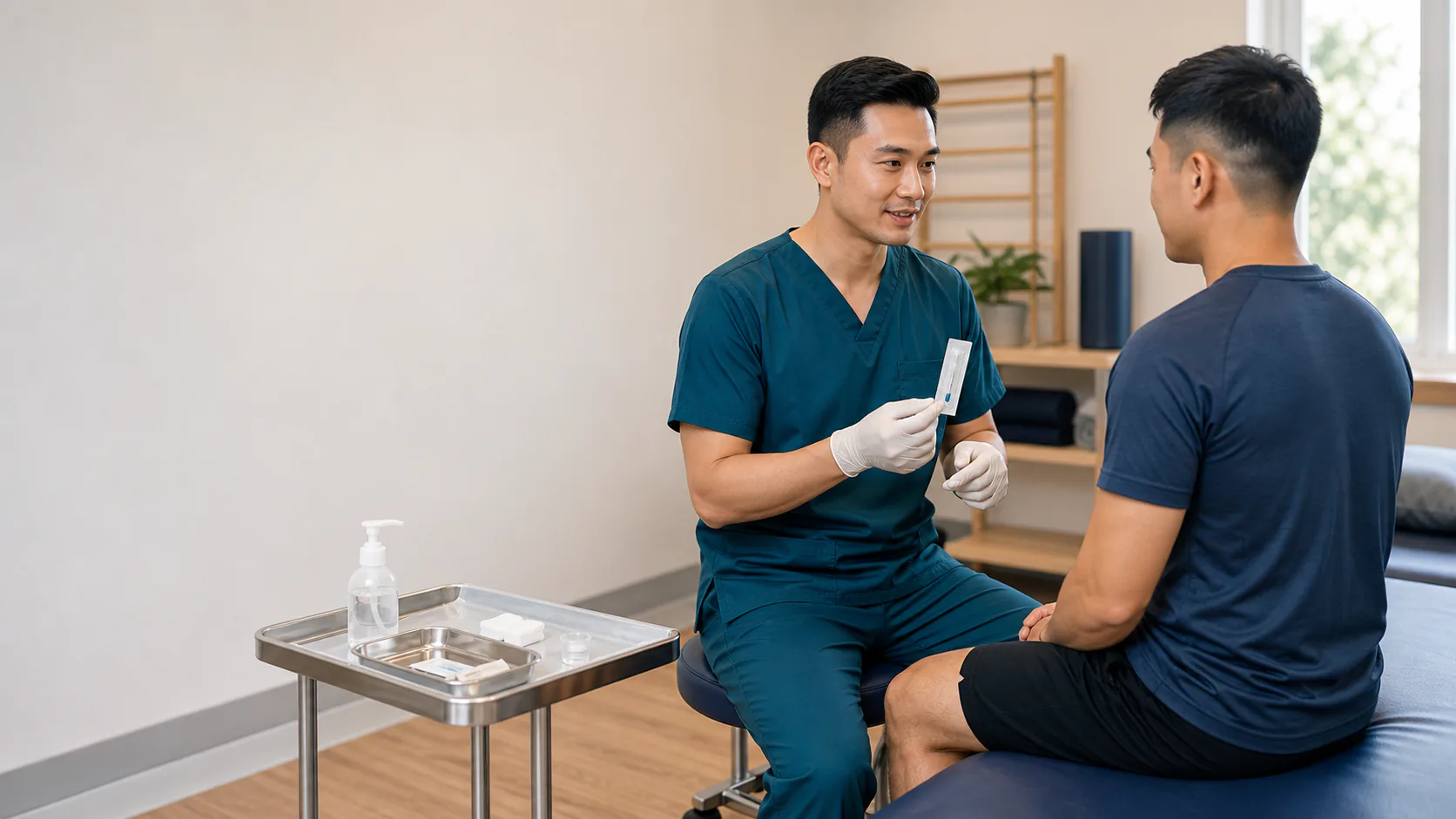
Release Deep Trigger Points That Nothing Else Can Reach
Thin filament needles inserted into muscle trigger points for immediate release. 70% of patients feel relief after one session.
That stubborn knot in your shoulder that no amount of massage can release. The tight band in your calf that cramps every time you run.
Some trigger points are too deep for hands to reach - dry needling goes straight to the source.
Dry needling uses a hair-thin filament needle (0.25mm - far thinner than injection needles) inserted directly into a muscle trigger point. When the needle hits the tight band, it causes a local twitch response - the muscle contracts sharply and then releases completely.
This breaks the pain-spasm cycle that has been maintaining the trigger point for weeks or months.
The evidence is compelling. A meta-analysis of 12 randomised controlled trials found dry needling reduces trigger point pain by 50-70% and improves range of motion significantly.
It works because the needle creates a micro-lesion that triggers a healing inflammatory response and resets the muscle's resting tone.
Dry needling is not acupuncture. Acupuncture targets meridian points based on traditional Chinese medicine theory.
Dry needling targets specific muscle trigger points identified through Western medical assessment. The needles look similar, but the theory, targets, and clinical reasoning are entirely different.
In Melaka, dry needling is kosong at several physiotherapy clinics and is particularly effective for chronic neck pain, upper back tension, and headaches caused by muscle trigger points.
运作方式
The science
Dry needling uses a thin, solid filament needle (the same kind used in acupuncture, but different philosophy and targeting) to penetrate a myofascial trigger point - a taut, irritable nodule in a muscle. The mechanical insertion triggers a local twitch response, disrupts the dysfunctional motor endplate, and produces a neurophysiological cascade: reduced peripheral nociception, altered descending pain modulation, and temporary inhibition of overactive muscle.
What you feel
Surprise at how thin the needle is - most patients do not feel insertion. When the physiotherapist reaches the trigger point, you will feel a brief, deep twitch or cramp that releases within a second.
Some patients describe mild soreness the next day, similar to after a good gym session. Numbness, tingling, or sharp lasting pain is not normal and the technique is adjusted immediately.
Session protocol
Skin is alcohol-swabbed, the physiotherapist palpates to the trigger point, inserts a needle (typically 30–50mm depending on muscle depth), and applies piston-like movement until twitch responses stop or fade. A session uses 3–8 needles across relevant muscles, and typically takes 10–20 minutes of actual needling within a 30–45 minute appointment.
Evidence base
Strong evidence for short-term pain reduction in myofascial pain syndrome, cervicogenic headache, plantar heel pain, and chronic low back pain. Moderate evidence for shoulder impingement, lateral epicondylitis, and knee osteoarthritis.
Effect is comparable to or slightly better than trigger-point manual release, with the advantage of reaching deeper muscles hands cannot access.
Who benefits most
Patients with clearly palpable, reproducible trigger points that reproduce familiar pain on compression. Common presentations: tension headache from upper trapezius and suboccipital triggers, lateral hip pain from gluteus medius triggers, "sciatica-feeling" pain from piriformis or deep gluteal triggers, and calf cramps from soleus triggers.
When it's not the right pick
Dry needling is avoided in patients with needle phobia, local infection, severe bleeding disorders, high-dose anticoagulation (case-by-case), and pregnant patients in the first trimester or over the abdomen and sacrum. It is not used as a replacement for imaging in red-flag presentations, and pain that is clearly radicular (nerve root) responds better to movement-based approaches.
Realistic timeframe
Immediate relief within the session is common but often partial. Cumulative benefit builds over 3–6 sessions when combined with corrective exercise.
If a trigger point keeps reloading week after week, the clinician should be hunting the driver - posture, movement fault, workload - not needling the same spot forever.
How it fits into the bigger plan
Dry needling is a precision reset. It is most powerful when used to release the one or two muscles that have been blocking progress in rehab, so exercise can do its job.
At PhysioMelaka it is always paired with motor re-education: needle the overactive muscle, then activate the underactive one. Needling without the re-education is a short-term fix on a loop.
可治疗的病症
背痛
Back pain affects 1 in 4 Malaysian adults. Physio finds and fixes the cause - disc, joint, or muscle - instead of masking it with painkillers. 78% improve within 4 sessions.
了解更多 →颈痛
Chronic neck pain from desk work, whiplash, or poor sleep posture. Targeted physio resolves 80% of neck pain cases within 3-4 weeks without medication.
了解更多 →肩痛
Shoulder pain from rotator cuff tears, impingement, or frozen shoulder. Physio restores full range of motion in 75% of patients within 8 weeks.
了解更多 →网球肘
Lateral epicondylitis from overuse. Physio treats the tendon dysfunction with eccentric loading - 80% resolution without injection or surgery.
了解更多 →相关服务
使用dry needling的物理治疗服务。
相关治疗方法
TENS Electrical Stimulation
Electrical nerve stimulation that blocks pain signals to the brain. Immediate relief for chronic pain conditions without medication side effects.
了解更多 →冲击波治疗
High-energy acoustic waves that restart healing in chronic tendon injuries. 76% success rate for conditions that resisted other treatments.
了解更多 →拔罐治疗
Suction cups that release deep muscle tension and improve blood flow. Used alongside physio exercise for faster muscle recovery.
了解更多 →Massage Therapy
Clinical massage techniques that release specific muscle trigger points and adhesions. Part of a treatment plan, not a spa experience.
了解更多 →博客文章
关于dry needling及相关主题的文章。
常见问题
No. Acupuncture follows traditional Chinese medicine meridian points. Dry needling targets specific muscle trigger points identified through Western medical assessment.
The needles are similar but the reasoning, targets, and treatment goals are different.
The needle insertion feels like a small pinch. When the needle hits a trigger point, you feel a brief muscle twitch - it is uncomfortable for 1-2 seconds but signals that the treatment is working.
Afterward, the area may feel bruised for 24-48 hours. Most patients say the brief discomfort is worth the lasting relief.
Most trigger points respond within 2-4 sessions. Chronic, long-standing trigger points may need 5-6 sessions.
Your physio reassesses after each session. Dry needling is always combined with exercise and stretching to prevent the trigger points from returning.
Yes. Every reputable physio clinic in Melaka uses sterile, single-use, disposable filament needles supplied in sealed packaging - the same standard as hospital needles.
Needles are opened in front of you, used once, and immediately disposed of in a medical sharps container. Your physio uses gloves and cleans your skin with alcohol before insertion.
Infection rates are vanishingly rare - far lower than 1 in 10,000.
Yes in most cases, but be aware that some patients feel unusually tired, sleepy, or lightly lightheaded for 1-2 hours after an intensive session - a normal post-needling parasympathetic response. If it is your first-ever session, consider having someone drive you or arrange Grab for the return trip.
Drink water, eat a small snack, and sit for 10 minutes before leaving. Avoid heavy exercise, sauna, and alcohol for 24 hours after.